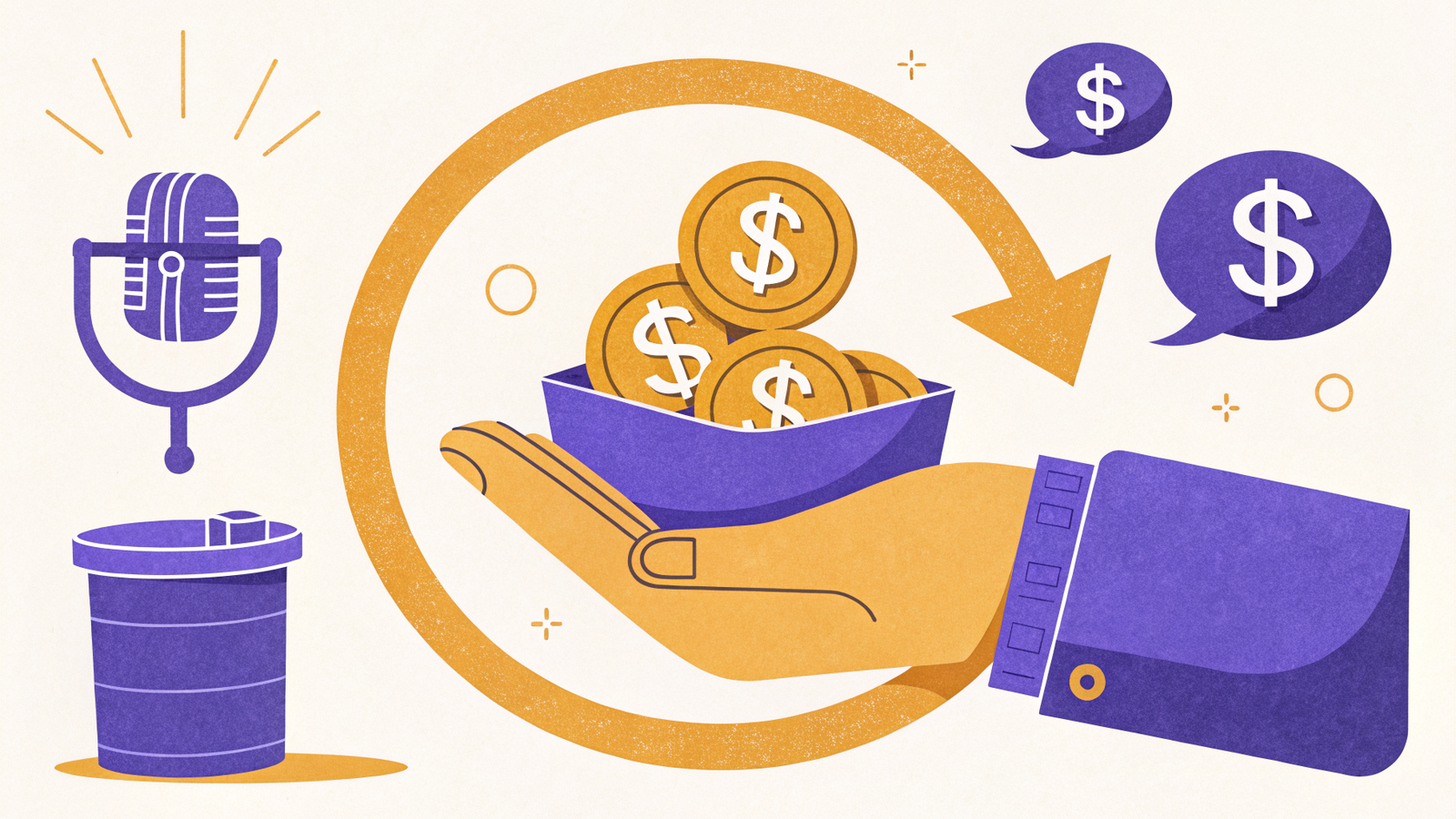
Acast helped make podcast advertising mainstream. Its marketplace and in-house sales team connect shows with brands that most independent creators would never reach on their own, and for some podcasters that demand is exactly what they need. So this is not a takedown. It is an honest look at when a network makes sense, and when keeping control of your own ads earns you more.
The trade-off sits at the centre of every alternative below. A network finds advertisers for you and takes a cut. A self-serve host lets you sell directly and keep the revenue, in return for doing the selling yourself. We make Springcast, so we will be upfront about where we fit, including the cases where another tool is the smarter pick.
Why look for an Acast alternative?
Acast is a capable platform, so the reasons to look elsewhere are rarely about quality. They are about fit. Three come up again and again.
You want to keep more of what your ads earn
A network model means someone else sells your inventory and takes a share of the result. That can be a fair trade when the network brings demand you could not land yourself. But once you have your own sponsors, or a niche audience a brand already wants to reach directly, the revenue share starts to feel like a tax on relationships you built. Selling your own ads on a flat-fee host flips that: you keep what you earn, and the platform cost stays the same whether a campaign is small or large.
You want to own your feed and audience
Independence is more than a principle. A marketplace optimises for its own fill rate and advertiser pool, not necessarily for your brand. Owning your feed, your RSS, your player and your listener data means you decide which sponsors fit, how often ads run, and what your show sounds like. For the wider case, see our guide on how to own your podcast audience.
You want EU privacy and clear data handling
Downloads tie IP addresses to listening behaviour, which is personal data under GDPR. Ad targeting can deepen that. If your audience, sponsors or clients sit in Europe, where listener data lives and how it is processed becomes a real question. An EU-hosted platform that targets at country level, without device fingerprinting, keeps that simpler.
The 7 best Acast alternatives in 2026
Seven options, what each is genuinely best for, and where the network-versus-self-serve line falls for each.
1. Springcast: best for keeping 100% of your ad revenue
This is us, so here is the honest pitch. Springcast is an all-in-one, EU-hosted platform with self-serve monetization built in. You bring your own advertisers, create a campaign with a CPM and a budget cap, insert it as pre-, mid- or post-roll through dynamic content, and track results in a revenue dashboard. Springcast does not take a revenue share on the ads you sell yourself; you pay a flat subscription, and you keep what you earn. Targeting is GDPR-first, at country level rather than via fingerprinting.
Strength: sell your own ads and keep the revenue, EU hosting and ISO 27001, all-in-one hosting plus analytics plus AI plus video. Weakness: if you want a network to find advertisers for you, Springcast does not run an ad sales house. Pricing: a flat subscription, see our pricing..
2. Spreaker: best for a programmatic ad marketplace
Owned by iHeartMedia, Spreaker leans into advertising. Its programmatic marketplace makes monetization accessible earlier than most, so creators who want demand brought to them, rather than selling direct, often start here.
Strength: a built-in ad marketplace and live streaming. Weakness: the marketplace model means a revenue share, and analytics are lighter than dedicated tools. Pricing: from a free tier up through paid plans; check current terms.
3. Megaphone: best for large publishers at scale
Megaphone, part of Spotify, targets professional publishers and networks that need enterprise-grade dynamic ad insertion and a connection to Spotify's ad demand. It is powerful, and priced and built for volume.
Strength: enterprise dynamic ad insertion and access to large advertiser demand. Weakness: aimed at big publishers, so it is overkill and over budget for most independent creators. Pricing: enterprise, by quote.
4. Captivate: best for growth-focused indie creators
Captivate puts marketing front and centre: a website builder, calls-to-action in the player, and sponsor kits that help you pitch brands yourself. If your plan is to land your own sponsors and grow a funnel, it is a natural fit.
Strength: growth and sponsorship tooling for selling direct. Weakness: no large in-house ad marketplace, so you do the selling. Pricing: tiered with unlimited uploads; check current plans.
5. Transistor: best for teams and multiple shows
Transistor lets you host unlimited shows on one plan and add team members without per-seat pain, which makes it a favourite for agencies and networks that sell their own sponsorships across a portfolio.
Strength: multiple shows under one roof, clean analytics, sell-direct friendly. Weakness: deliberately minimalist, with no native ad marketplace. Pricing: tiered by downloads; verify current rates.
6. Buzzsprout: best for beginners
Buzzsprout is clean and one of the easiest ways to publish a first episode. It offers an affiliate-style marketplace for monetization rather than a full sales house, which suits creators who are just getting started.
Strength: simple, beginner-friendly, reliable. Weakness: US-based, lighter on advanced analytics and self-serve campaign control. Pricing: by upload hours per month; see our Buzzsprout alternatives guide for the wider field.
7. Spotify for Creators: best free option
Formerly Anchor, Spotify for Creators is free and tightly integrated with Spotify, including native ad tools. For hobbyists testing an idea with no budget, free is hard to argue with.
Strength: free hosting and Spotify-native ad features. Weakness: you build on a platform that owns the relationship, with weaker portability and cross-platform data. Pricing: free.
Acast alternatives compared
The fast version. Network terms and pricing change often, so treat the table as a prompt to check each host's current plans rather than a quote.
| Host | Who owns the feed | Ad-revenue share | EU / GDPR | Analytics | Best for |
|---|---|---|---|---|---|
| Springcast | You | None on ads you sell (flat fee) | Yes (EU-hosted, ISO 27001) | Deep (retention, geography) | Keeping 100% of ad revenue |
| Acast | You | Yes (network sales house) | Partial | Solid | Network-sold ads |
| Spreaker | You | Yes (marketplace) | No (US) | Lighter | Programmatic marketplace |
| Megaphone | You | Enterprise terms | Partial | Enterprise | Large publishers |
| Captivate | You | Sell direct (no big marketplace) | No | Solid | Growth-focused indies |
| Transistor | You | Sell direct (no marketplace) | No | Clean | Teams & multiple shows |
| Buzzsprout | You | Affiliate-style marketplace | No (US) | Basic | Beginners |
| Spotify for Creators | Platform-leaning | Spotify ad tools | No | Some (Spotify) | Free / hobbyists |
Keep 100% of your ad revenue: how self-serve monetization works
Self-serve monetization sounds technical, but the idea is plain: you sell, you keep. Instead of a network placing ads and taking a cut, you bring the advertiser and run the campaign yourself. On Springcast that flow is built into the platform.
- Create a campaign with a CPM (the price per thousand impressions) and a budget cap, so spend never runs past what you agreed.
- Choose the slot, pre-roll, mid-roll or post-roll, and insert it through dynamic content so it can update later without re-uploading episodes.
- Bring your own advertisers, the local sponsor, the brand in your niche, the partner you already talk to.
- Track results in a revenue dashboard, then adjust the CPM or cap as the campaign runs.
Because there is no revenue share on what you sell, a bigger deal does not mean a bigger platform bill. The flat fee stays flat. To see the tooling, visit Springcast growth tools, and for the wider picture our guide on how to monetize a podcast covers sponsorships, memberships and more.
A network finds the advertiser and takes a cut. Self-serve lets you keep the relationship, and the revenue.
Network vs self-serve: which earns you more?
There is no universal answer, and anyone who gives you one is selling something. The honest version is a calculation.
A network earns its cut when it brings demand you could not land alone. If you have a small or new audience and no sponsor relationships, a marketplace filling your inventory at all is worth more than 100% of nothing. That is a genuine case for Acast or another sales house.
Self-serve wins when you already have, or can build, direct demand. A niche show with engaged listeners is exactly what a relevant brand wants, and a network sitting in the middle of that deal is taking a share of value you created. The same logic applies once your downloads grow: a fixed subscription becomes cheap relative to a percentage of rising ad revenue.
📋 Pick self-serve if
- You already have sponsors, or can find brands in your niche directly
- Your audience is engaged and specific, the kind a brand targets on purpose
- Your ad revenue is growing and a percentage cut is starting to add up
- You want to control which sponsors run and how often
- You want your listener data and feed to stay yours, hosted in the EU
How to switch without losing your feed
The fear that stops most people from switching is losing subscribers. You will not, if you do it in order. Every serious host supports a 301 redirect that points your old feed at the new one, so listening apps move everyone across automatically.
- Import your back catalogue to the new host first, so nothing is missing.
- Set the 301 redirect from your old feed to the new one.
- Keep both feeds live for a few weeks while apps catch up.
- Wind down network campaigns in line with your contract, then start selling direct.
For the full technical walkthrough, how to migrate your podcast host covers the move step by step. If you are also weighing the big platforms, Springcast vs Spotify for podcasters compares ownership and reach, and you can see the core platform on Springcast hosting and distribution.
Frequently asked questions
So which Acast alternative should you pick?
If you need a network to find advertisers and fill inventory you cannot sell yourself, Acast, Spreaker or Megaphone earn their cut. If you already have, or can build, direct sponsor relationships and want to keep what you earn, a self-serve host is the smarter long-term call. That is where Springcast fits: sell your own ads, keep 100% of the revenue, own your feed, and host in the EU. Match the model to your next twelve months, then start a free trial and feel the difference before you commit.