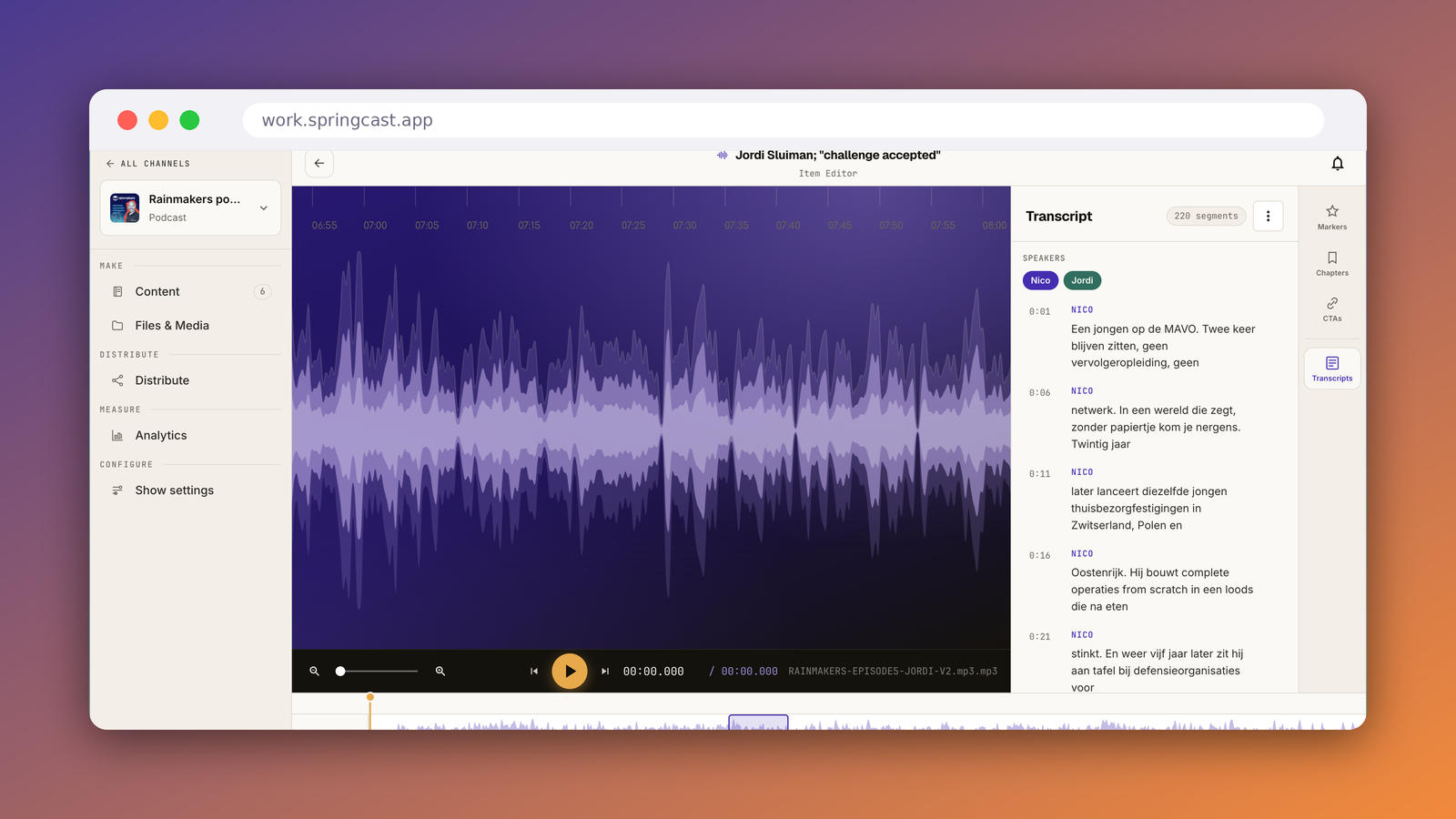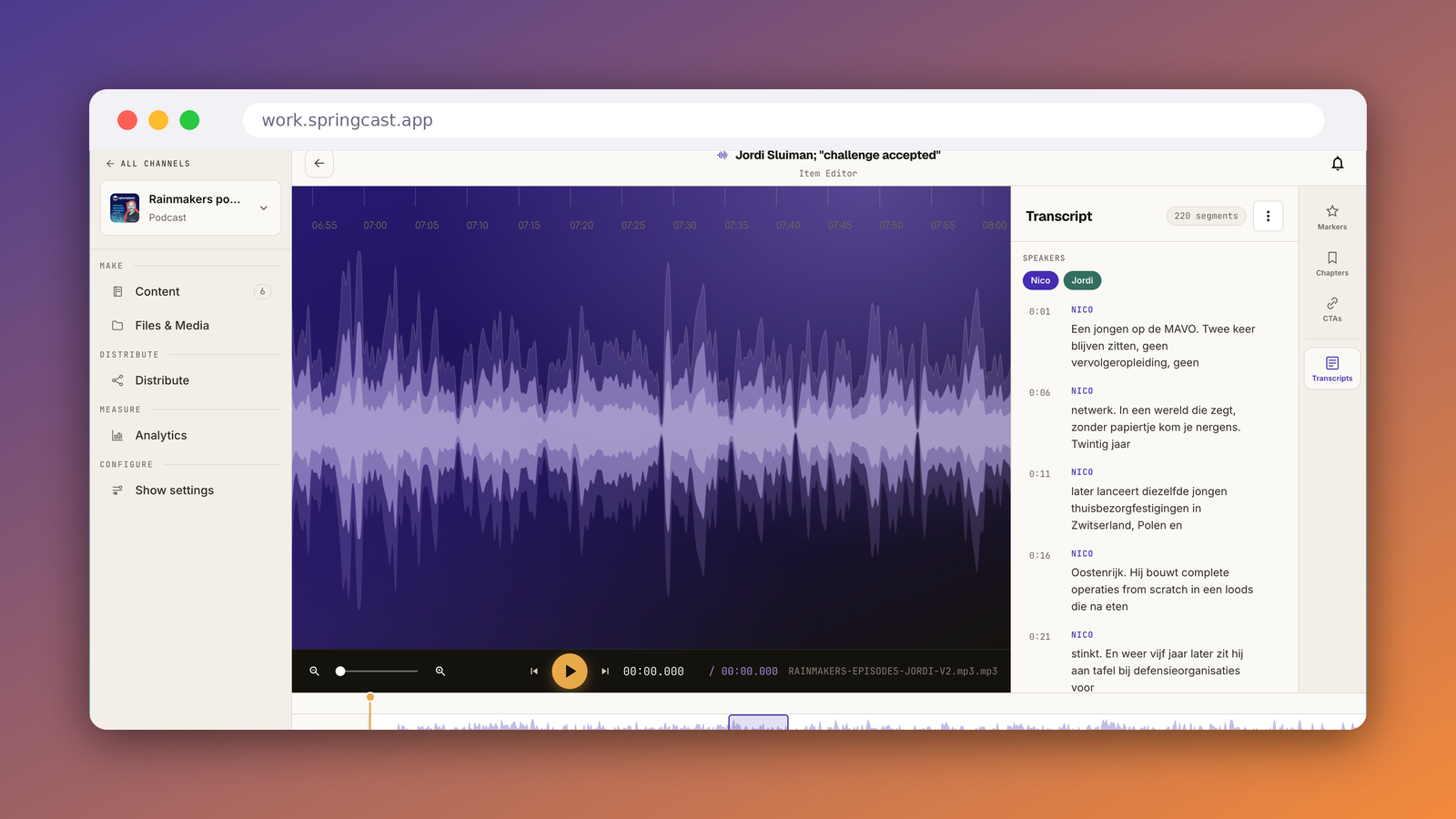
The average accessibility audit covers contrast, headings and forms. The podcast on the same website escapes scrutiny, even though audio without a text alternative locks out an entire group of visitors.
An accessible podcast has a full transcript with every episode. WCAG sets that requirement at level A, the baseline of the guidelines (success criterion 1.2.1 for prerecorded audio). Public-sector bodies across the EU are bound to that standard through the Web Accessibility Directive; in the Netherlands it has applied since 2020 through the Digital Government Act. And since 28 June 2025 the European Accessibility Act imposes comparable requirements on banks, webshops and other providers of essential services. The same transcript that covers the obligation makes episodes readable, searchable and quotable for everyone who does not listen.
What WCAG actually asks of audio
For prerecorded audio without video, WCAG asks for a text alternative that carries the same information: who says what, plus sounds that carry meaning. That is success criterion 1.2.1, weighted at level A, the absolute minimum. Anyone aiming for the widely used WCAG 2.1 AA standard cannot skip audio; the A criteria are part of it.
A summary or show notes will not do. They describe the episode, whereas the transcript stands in for it. Chapters and timestamps help readers and listeners navigate and make a useful addition to the transcript, never a substitute for it.
Who is already required to comply
For the public sector the question is settled. The EU Web Accessibility Directive, implemented in the Netherlands through the Digital Government Act and its accessibility decree, requires public-sector websites and apps to meet EN 301 549, which incorporates WCAG 2.1 at levels A and AA, with a public accessibility statement per website. A podcast that a municipality, ministry or agency publishes on its own site falls squarely within that scope.
The private sector is next. Since 28 June 2025 the European Accessibility Act applies to banking services, e-commerce, e-books and streaming services, among others; in the Netherlands the AFM supervises banks and financial service providers. Micro-enterprises with fewer than ten employees and under 2 million euro in turnover are exempt. Exactly where the line sits for editorial content such as a podcast on a bank’s or insurer’s website has not yet crystallised. Organisations covered by the act that take their channels seriously hold audio to the same standard as the rest of the site.
Accessibility is also reach
Over 430 million people worldwide live with disabling hearing loss, more than five per cent of the world’s population; by 2050 the WHO projects nearly 2.5 billion people with some degree of hearing loss (fact sheet, 3 March 2026). That is an audience you do not reach without text.
The transcript also serves readers without hearing loss: the colleague in a quiet office, the student scanning for an exam, the non-native speaker who wants to reread a passage. And it serves machines. Search engines and AI assistants do not listen; they index and quote text. An episode with a transcript competes in search results and AI answers, an episode without one is absent there. Our article on AEO for podcasts covers how to grow that presence.
How to make it work
The workable route: generate the transcript automatically, review it for names, numbers and jargon, label the speakers and publish the text in the same place as the episode. Add chapters so readers and listeners can jump to the part they need. Schedule the editing pass right after the final edit, so it becomes a fixed step rather than a loose chore afterwards.
At Springcast, unlimited transcripts are included from the Professional plan up. You generate them with Sky AI and refine them in the built-in editor; chapters are available on every plan. The platform runs on European infrastructure with EU data residency, and Springcast is ISO 27001:2022 certified, which shortens vendor assessments for public-sector and regulated organisations. See how transcripts and Sky AI work on the platform page, or book a demo to try it with your own episodes.