
Colleagues without a desk, a work email address or a PC: how to reach them, what the European rules say, and how to prove the message arrived.
Last updated 2 October 2026 · Figures checked on 30 September 2026
Deskless workers spend the working day on the move or on the floor: home care nurses, technicians on the road, drivers, production and warehouse staff. You reach them on their own phone, at moments already in their day, like the drive between jobs or the start of a shift, and in the voice of someone they trust. Then you check, group by group, that the message arrived.
Most internal communication channels assume a desk. Written for communication, HR and IT teams in European organizations, this guide uses Eurostat data, explains the rules on works councils, privacy, working time and driving, and ends with a pilot of at least three months.
In short
In 2022, 41.9% of employed people in the EU spent little or none of their working time on digital devices, according to a calculation based on Eurostat data.
Email and the intranet miss them for practical reasons: no account, no screen on shift, rotating hours, language.
Reach them in the drive or at the start of a shift, through a team lead they know.
Measure per group, keep mandatory listening in working hours, and give a pilot at least three months.
What is a deskless worker?
A deskless worker is an employee who does most of their work away from a desk and a computer: on a ward, in a client's home, in a van or on a production line. Eurostat does not use the term as a statistical category.
Deskless worker (non-desk worker) · What it describes: Most of the work happens away from a desk · Examples: Home care nurse, production operator
Frontline worker · What it describes: Direct contact with customers, patients or the product; some frontline jobs are desk jobs · Examples: Nurse, shop assistant, call center agent
Blue-collar worker · What it describes: Manual work in production, construction, maintenance or logistics · Examples: Electrician, warehouse worker
Field staff (field workers) · What it describes: Work at changing locations, usually with driving in between · Examples: Service engineer, sales rep, inspector
Shift worker · What it describes: Work in rotating or irregular hours · Examples: Care, production, transport
In 15 conversations with 11 European organizations about internal audio, between August and September 2026, nobody on the client side called their people deskless or frontline. They talked about colleagues in the car, on the road or in the field, and most of them called what they wanted an internal podcast.
How many deskless workers are there in Europe?
No official statistic counts deskless workers directly, but Eurostat measures something close. In 2022, 41.9% of employed people aged 15 to 74 in the EU, about 84.6 million, spent little or none of their working time on digital devices, according to a calculation based on Eurostat's Labour Force Survey.
The same 2022 Eurostat data show that 26.7% of employed people in the EU, about 53.9 million, spent none of their working time on digital devices.
Figure 1 compares both measures for the EU, the Netherlands, Germany and Denmark, and shows what share in each gave no answer.
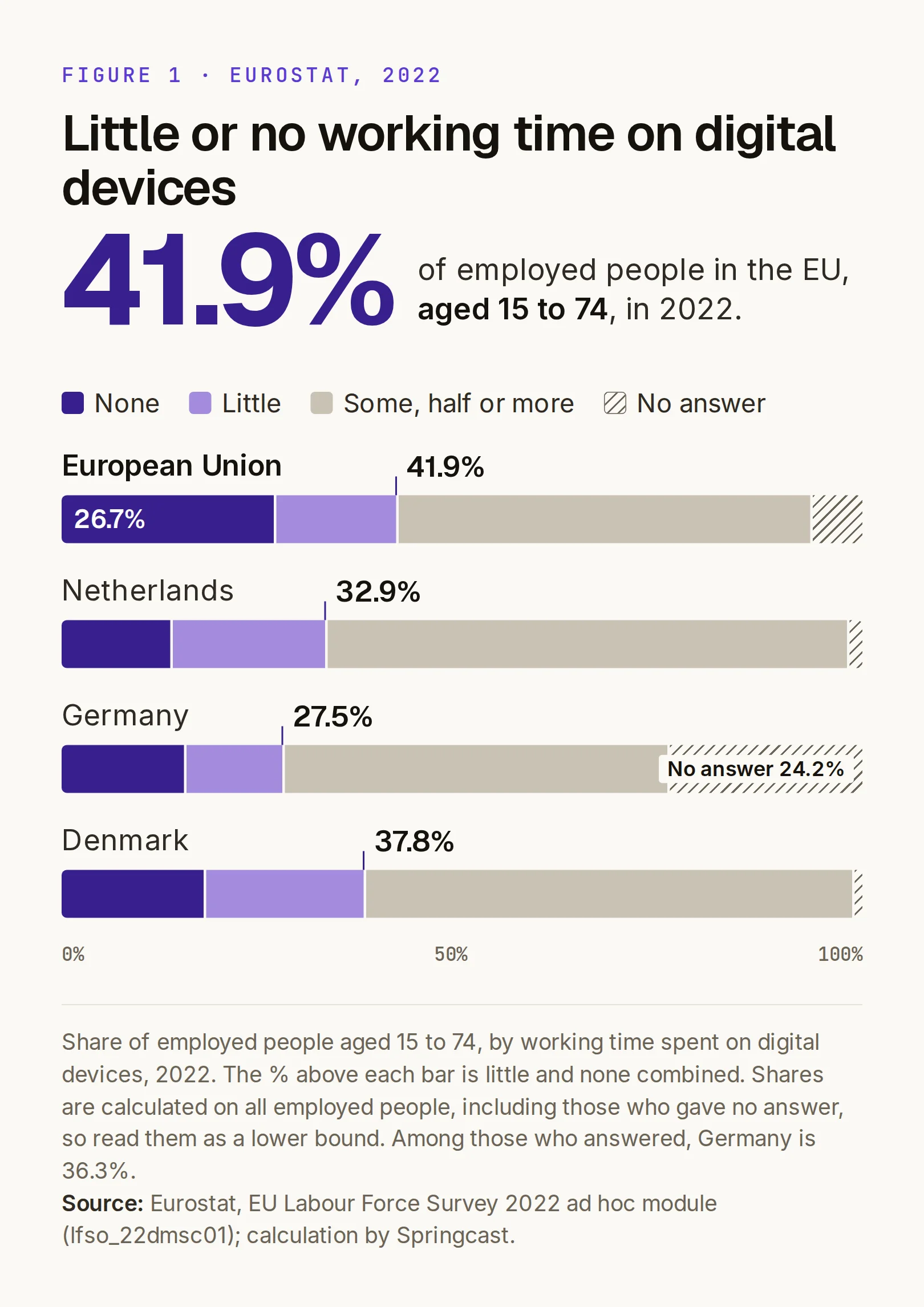
Little or no working time on digital devices (2022)* · EU: 41.9% · Netherlands: 32.9% · Germany: 27.5% · Denmark: 37.8%
No working time on digital devices (2022)* · EU: 26.7% · Netherlands: 13.7% · Germany: 15.4% · Denmark: 17.9%
Never work from home (2025) · EU: 77.0% · Netherlands: 47.7% · Germany: 75.4% · Denmark: 59.3%
Staff with internet access for work, enterprises with 250+ employees (2025) · EU: 68.4% · Netherlands: 77.6% · Germany: 72.2% · Denmark: 86.1%
Employees working shifts (2025) · EU: 17.4% · Netherlands: 14.8% · Germany: 14.6% · Denmark: 11.0%
Used the internet on a mobile phone or smartphone, aged 25 to 54 (2025) · EU: 95.0% · Netherlands: 99.4% · Germany: 92.0% · Denmark: 97.7%
* Shares are calculated on all employed people, including those who gave no answer: 24.2% in Germany and 6.3% in the EU as a whole. Read those figures as a lower bound. Rows 1 and 2 are a calculation based on Eurostat figures in thousands. Datasets: lfso_22dmsc01, lfsa_ehomp, isoc_ci_cm_ps, lfsa_ewpshi, isoc_ci_dev_i. The enterprise survey does not cover hospitals, schools or public administration.
By sector, in businesses with ten or more employees, the share of staff with internet access for work in 2025 was 46.2% in accommodation and food services, 56.6% in construction and 58.1% in manufacturing, according to Eurostat's survey on ICT use in enterprises.
Global percentages for the deskless workforce circulate widely, usually without a published method. Each Eurostat figure above links to a dataset with a definition, a population and a year.
Why email and the intranet do not reach them
Email and the intranet assume three things: an account, a screen and time to read at that screen. During a shift, many deskless workers have none of them, and the message may be written in a language or at a reading level they struggle with.
We found no independent figure for how many European employees lack a company email address; the percentages that circulate come from software vendors. The closest measure is internet access for work, in the table above.
Eurostat puts the share of EU employees working shifts at 17.4% in 2025, so a town hall at ten on a Tuesday misses every shift that is off duty. A canteen screen has the same limit, as our piece on digital signage shows.
For some colleagues, language or reading level is the barrier. EU-OSHA's ESENER survey found that in 2024, 10% of establishments in the EU had employees who found it difficult to understand the language spoken at the premises, up from 8% in 2019. In the OECD Survey of Adult Skills 2023, 16% of adults in the Netherlands and 22% in Germany scored at Level 1 or below in literacy, against an OECD average of 26%. A channel built on long text loses those readers first.
Information overload comes on top: in Gallagher's Employee Communications Report 2026, 83% of the communication and HR professionals surveyed called it a growing problem, and in enterprises with 10,000 or more employees, 93% reported a significant impact.
Several organizations we spoke to this year described the same shelf: recorded trainings, intranet articles, a video series that stops as soon as the phone screen locks. All of it was made for someone sitting at a screen.
Reach them in moments they already have
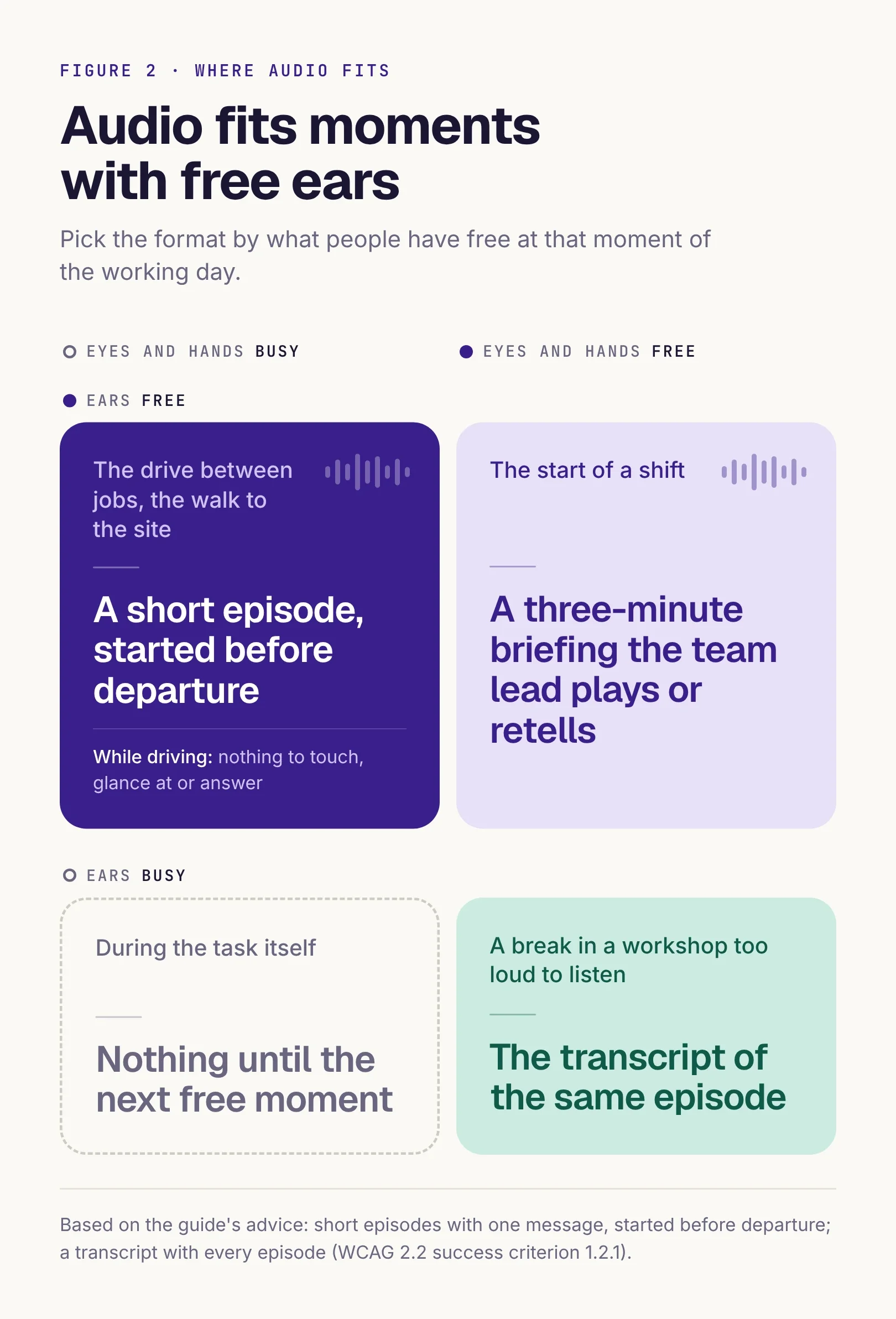
Deskless workers have moments without a screen but with free ears: the drive between jobs, the walk to the site, the start of a shift, a break. Audio fits those moments, as long as each episode is short and carries one message.
Figure 2 sorts the moments of a working day by whether ears, eyes and hands are free, and shows which format, if any, fits each.
Eurostat's survey on ICT use in households found that in 2024, 27.8% of people aged 16 to 74 in the EU had listened to or downloaded podcasts in the previous three months, with 42.1% in the Netherlands and 28.8% in Germany. For the car, Edison Research's The Infinite Dial 2026 found that 37% of Americans aged 18 and over who drove or rode in a car in the past month use podcasts as an audio source in their car, rising to 55% among 18- to 34-year-olds. That is a US figure.
Write for someone who is doing something else: five to eight minutes, the decision in the first minute, the key point said twice. For the start of a shift, three minutes is enough. The format itself is covered in our guide to internal podcasting.
The W3C's WCAG 2.2 success criterion 1.2.1 (Level A) asks for an equivalent text alternative, such as a transcript, for prerecorded audio, so give every episode one. The transcript also serves the colleague who reads along in a second language, or who works in a workshop too loud to listen.
Safety first when people drive
When people drive, the road comes first. Start the episode before departure, and leave anything that needs a touch, a glance or an answer until after the drive.
In the Netherlands, article 61a of the traffic regulations RVV 1990 prohibits holding a mobile device while driving; hands-free use and voice control are allowed, according to the Dutch government's explanation of the rule (August 2026). The same page advises keeping the volume low or using one earbud.
The European Commission's road safety observatory adds a caution in its 2023 report on driver distraction: it calls hands-free phoning "probably risky" and the effect of listening to music while driving "unclear". Rules differ per country; check yours with your safety or legal team.
Use the phone they already carry
Use the personal smartphone: in 2025, 95.0% of people aged 25 to 54 in the EU used the internet on a mobile phone or smartphone, according to Eurostat.
In 2024, 58.4% of large EU enterprises gave more than a fifth of their staff a portable device with mobile internet, according to Eurostat's data on portable work devices, so a work device is not a given.
Personal phones raise a privacy question that the EU's Article 29 Working Party addressed in Opinion 2/2017 on data processing at work: monitoring an employee's own device may be unlawful when it also captures data about their private and family life. Keep the app narrow, holding the organization's content and nothing else, and check that design with your DPO before the first invitation.
Access without a company email address
Employees without a company email address can still sign in: invite them on a personal email address, or through single sign-on if your identity provider already holds an account for them. Settle three situations with IT first.
Staff turnover makes automatic provisioning worth asking about. Where many people join and leave every month, manual invitations fall behind and former employees keep access; automatic provisioning from the directory, for example through the SCIM standard, handles both. In our conversations, the IT teams that asked for it pointed to turnover.
A lost or replaced phone should end access: check that removing the device in the admin also removes access to the content.
Where a team shares a device, each person signs in and out. Settle the device question early too: a handheld issued for work may not allow other apps, which moves the pilot to personal phones.
Let managers and colleagues do the talking
Use the voices deskless workers already hear on every shift: their team lead and the colleagues around them. Give those people something to pass on: a three-minute audio briefing the team lead plays or retells at the start of a shift, and episodes in which colleagues explain their own work.
Gallagher's Employee Communications Report 2026 calls line managers "one of the most relied upon communication channels", especially for frontline and distributed workforces. It also found that 87% of respondents see managers lacking skills and capacity as a moderate or significant risk, while only 21% actively use manager toolkits. A recorded briefing is a small toolkit, and it arrives in a voice the team knows.
The same 2026 report shows respondents in frontline-heavy organizations rating in-person town halls as their single most effective channel (51%), with the score dropping 18 points when the town hall goes virtual. Audio carries a voice to the shifts that were not in the room.
Contractors in the Netherlands and Belgium already give frontline communication a fixed rhythm: the VCA checklist 2017/6.0 by SSVV requires toolbox meetings at least four times a year for VCA* and ten for VCA**. By exception, and with justification, they may take another form, with a yearly minimum of contact moments or meetings at half that number. Whether an audio briefing counts is for your certifying body to say.
In our conversations, several organizations described colleagues and specialists from the floor as the voices that land, more than the quarterly update. Two worries came back: whether anyone would listen, and tone, meaning top-down messages nobody asked for.
In our experience, a new internal podcast spreads fastest when you interview a different colleague or manager every week. People give a new show a try sooner when someone they know is in it.
When US emergency dispatchers shared advice anonymously with peers in other cities for six weeks, burnout fell by 8 points and resignations more than halved, according to a field experiment by Linos, Ruffini and Wilcoxen in the Journal of Public Administration Research and Theory (2022). It was not a podcast; read it as an analogy.
Measure what arrived without listing who listened
Measure three things for each group: reach, understanding and application. None of them needs a list of who listened. Individual listening data is personal data, and in the Netherlands and Germany a system that could monitor behavior needs the consent or co-determination of the works council, where there is one.
According to Gallagher's Employee Communications Report 2026, 70% of communicators track only outputs such as opens, clicks and views; 16% measure outcomes, and 12% look at business impact (n=474).
Reach is the share of a group that heard at least one episode. Understanding is whether people can answer three questions about the message, in a team meeting or an anonymous pulse. Application is one behavior you can observe, such as a new procedure in use. Agree a minimum group size for your own team or site reports, and suppress results below it.
In the Netherlands, article 27(1) of the Works Councils Act (WOR) requires the works council's consent for a regulation on processing and protecting the personal data of people working in the company (sub k), and for a regulation on facilities aimed at or suitable for monitoring attendance, behavior or performance (sub l).
In Germany, section 87(1) no. 6 of the Works Constitution Act (BetrVG) gives the Betriebsrat co-determination over technical facilities designed to monitor behavior or performance. The Federal Labour Court ruled in 2016 (1 ABR 7/15) that a system counts when it is objectively suitable for that ("objektiv geeignet"), whatever the employer intends.
Employee consent does not settle the privacy question. Recital 43 of the GDPR says consent should not be a valid legal ground where there is a clear imbalance between the parties, and WP29 Opinion 2/2017 notes that employees are seldom in a position to freely give, refuse or revoke consent.
This is not legal advice. Agree on what you measure, and whether the pilot needs a data protection impact assessment (DPIA), with your works council, DPO or legal team before the pilot starts.
Put mandatory messages in working time
If people must listen, schedule it in their working hours. Vocational training required by the employer counts as working time. Where the employer must provide that training under EU or national law or a collective agreement, it must also be free and scheduled during working hours where possible. Ask HR or legal to assess optional listening outside the roster.
The Court of Justice of the EU ruled in 2021 (C-909/19) that vocational training required by the employer is working time under the Working Time Directive, in a case about training at a provider's premises. Article 13 of Directive (EU) 2019/1152 applies to training an employer must provide under EU or national law or a collective agreement so employees can do their jobs. It requires that training to be free, treated as working time and scheduled during working hours where possible.
The Netherlands has the same rule in article 7:611a(2) of the Civil Code. In Germany, section 111(2) of the Trade Regulation Act (GewO) says such training should take place during regular working hours, and counts as working time when it has to happen outside them.
Treat an episode people must hear, such as a safety instruction or a new procedure, the same way: put it in the shift, and label everything else as optional. How that time is paid follows the contract and collective agreement; check with HR or legal.
Prove it in a pilot of at least three months
Run one pilot: one group of 50 to 150 people, one show, one episode of five to eight minutes a week, for at least three months. In our experience, an internal podcast takes three to six months to land; after one month you see early reach, not yet the result. Agree on success criteria and sign-offs before day one, and start early enough for the decision to land before your budget is set.
Price rarely slowed a decision in the conversations behind this guide; the approval chain and the budget calendar did. A pilot that ends after the budget round can wait a year for its second group, so count back from the deadline: three months of episodes, plus the sign-offs before day one.
Pick the group your channels reach least, or the one where a result would convince most people, and one question the pilot has to answer.
Write the success criteria down first: reach, understanding (three questions), application, and five short conversations in the group.
Plan three months of weekly episodes, each with a different colleague or manager: a team lead explaining one decision, a colleague from the floor, a safety moment, the answer to a question someone asked.
Get the sign-offs before day one: IT and security, the DPO, the works council or Betriebsrat, HR or legal on working time, and safety for drivers.
Keep reporting at group level, with the minimum group size you agreed: reach after the first month, understanding and application at the end.
Decide after three months, against your budget calendar.
The app side of a first rollout is in our deep dive on an internal podcast in your own app; the budget conversation is in the business case for an internal podcast.
What to look for in a channel for deskless employees
Look for a channel that works on people's own phones without a company email address and fits your identity setup and your groups. For frontline employee communication, it should carry audio with a transcript and report at group level, at a price that does not rise with headcount.
Works on the employee's own phone, without a company email address
Single sign-on, plus automatic provisioning (for example through SCIM) for joiners and leavers
Groups by role, region and shift decide who sees what
Push notifications only for what someone follows
Audio and video, with a transcript that runs along
Episodes in the languages your people speak, each with its own transcript
Reporting by group, with no listening lists per person
EU data storage, ISO 27001:2022 certification and a data processing agreement (DPA)
A price that does not rise with every person you reach
Springcast Mobile, the internal podcast app for organizations, covers part of this list: colleagues install it from the App Store or Google Play, join by invitation and start sign-in with an email address, with optional single sign-on through their organization’s identity provider. Groups linked to shows decide who sees what, new-episode push notifications go only to people who follow a show and have notifications enabled, and the player shows a running transcript in the language of the episode. For Mobile SSO, SCIM supports adding and updating users, changing group memberships, and suspending or deleting access. The app interface supports ten languages; this does not translate episode audio or transcripts. Listening statistics by show come from the platform’s analytics module, and there is no price per mobile user and no listener limit. SSO availability depends on the chosen plan.
For the IT and privacy review, in the words of our security page: "Our applications run in the Netherlands, Germany and Finland." The certification, in the same words: "ISO/IEC 27001:2022, independently certified by Brand Compliance under RvA accreditation (C 548)." On request, a compliance officer takes your team through the security questionnaires.
Frequently asked questions
What is the difference between deskless and frontline workers?
Deskless describes where the work happens: away from a desk. Frontline describes who the work serves: customers, patients or the product. A home care nurse is both; a call center agent is frontline and works at a desk all day.
How do you communicate with employees without a company email address?
Use a channel on their own phone that does not depend on a company mailbox. Invite people on a personal email address or through single sign-on, and agree with IT beforehand how joiners, leavers and lost phones are handled.
How do you reach field staff who drive a lot?
Use the drive with care. Short audio episodes that start before departure and need no touch or glance on the road fit the time between jobs. Keep each one to a single message and save questions for the next stop.
Do we need works council approval to measure listening?
It depends on what the system could monitor, not only on what you report. In the Netherlands, a regulation on facilities suitable for monitoring attendance, behavior or performance needs works council consent (WOR article 27(1)(l)); in Germany, the Betriebsrat co-determines on systems objectively suitable for monitoring (BetrVG section 87(1) no. 6). Involve the works council before the pilot.
Is mandatory training outside working hours paid?
Employer-required vocational training counts as working time under C-909/19 (2021). Article 13 of Directive (EU) 2019/1152 adds requirements for training employers must provide under law or a collective agreement. Pay depends on applicable national law, collective agreements and contractual terms. For optional listening outside the roster, ask HR or legal to assess the circumstances.
Can employees listen to work audio while driving?
In the Netherlands, holding a phone while driving is prohibited (RVV 1990, article 61a); hands-free use and voice control are allowed, according to the Dutch government. The European Commission's road safety observatory still calls hands-free phoning "probably risky". Start episodes before departure, and check the rules in every country where your people drive.
Sources
Eurostat. Employed persons by working time spent on using digital devices (lfso_22dmsc01), EU Labour Force Survey, 2022 ad hoc module. 2022 data, updated 2026. https://ec.europa.eu/eurostat/databrowser/view/lfso_22dmsc01/default/table?lang=en
Eurostat. Employed persons working from home (lfsa_ehomp). 2025. https://ec.europa.eu/eurostat/databrowser/view/lfsa_ehomp/default/table?lang=en
Eurostat. Persons employed with access to the internet for business purposes (isoc_ci_cm_ps and isoc_ci_cm_pn2). 2025. https://ec.europa.eu/eurostat/databrowser/view/isoc_ci_cm_ps/default/table?lang=en · https://ec.europa.eu/eurostat/databrowser/view/isoc_ci_cm_pn2/default/table?lang=en
Eurostat. Enterprises providing portable devices for business purposes (isoc_cimobe_use). 2024. https://ec.europa.eu/eurostat/databrowser/view/isoc_cimobe_use/default/table?lang=en
Eurostat. Devices used to access the internet (isoc_ci_dev_i). 2025. https://ec.europa.eu/eurostat/databrowser/view/isoc_ci_dev_i/default/table?lang=en
Eurostat. Employees working shifts (lfsa_ewpshi). 2025. https://ec.europa.eu/eurostat/databrowser/view/lfsa_ewpshi/default/table?lang=en
Eurostat. Internet use: listening to or downloading podcasts (isoc_ci_ac_i). 2024. https://ec.europa.eu/eurostat/databrowser/view/isoc_ci_ac_i/default/table?lang=en
EU-OSHA. First findings of the Fourth European Survey of Enterprises on New and Emerging Risks (ESENER 2024). 2025. https://osha.europa.eu/sites/default/files/documents/first-findings-esener-2024_EN.pdf
OECD. Survey of Adult Skills 2023: Country notes, Netherlands and Germany. 2024. https://www.oecd.org/content/dam/oecd/en/publications/reports/2024/12/survey-of-adults-skills-2023-country-notes_df7b4a60/netherlands_7e674f6c/bdaa68d1-en.pdf · https://www.oecd.org/content/dam/oecd/en/publications/reports/2024/12/survey-of-adults-skills-2023-country-notes_df7b4a60/germany_264dd624/5f81cb66-en.pdf
Gallagher. Employee Communications Report 2026. 2026. https://www.ajg.com/employeeexperience/-/media/files/gallaghercomms/gcommssite/state-of-the-sector/gallagher-employee-communications-report-2026-global.pdf
Edison Research. The Infinite Dial 2026. 2026. https://www.edisonresearch.com/wp-content/uploads/2026/03/The-Infinite-Dial-2026-Presentation.pdf
European Commission, European Road Safety Observatory. Road Safety Thematic Report: Driver Distraction. 2023. https://road-safety.transport.ec.europa.eu/system/files/2024-01/ERSO-TR-Distraction_2023-12-19.pdf
Linos, E., Ruffini, K. and Wilcoxen, S. Reducing Burnout and Resignations among Frontline Workers: A Field Experiment. Journal of Public Administration Research and Theory, 2022. https://doi.org/10.1093/jopart/muab042
SSVV. VCA-checklist 2017/6.0. 2017. https://ssvv.nl/app/uploads/2026/01/VCA-checklist-2017-6-0.pdf
W3C. Understanding WCAG 2.2: Success Criterion 1.2.1 Audio-only and Video-only (Prerecorded). 2026. https://www.w3.org/WAI/WCAG22/Understanding/audio-only-and-video-only-prerecorded.html
Dutch government (wetten.overheid.nl). Wet op de ondernemingsraden, article 27. Text in force, consulted 30 September 2026. https://wetten.overheid.nl/jci1.3:c:BWBR0002747&hoofdstuk=IVA&artikel=27
German Federal Ministry of Justice (gesetze-im-internet.de). Betriebsverfassungsgesetz, § 87. Text in force, consulted 30 September 2026. https://www.gesetze-im-internet.de/betrvg/__87.html · Bundesarbeitsgericht, 1 ABR 7/15, 2016. https://www.bundesarbeitsgericht.de/entscheidung/1-abr-7-15/
EUR-Lex. Regulation (EU) 2016/679 (GDPR), recital 43. 2016. https://eur-lex.europa.eu/eli/reg/2016/679/oj
Article 29 Working Party. Opinion 2/2017 on data processing at work (WP249). 2017. https://ec.europa.eu/newsroom/article29/items/610169
Dutch government (wetten.overheid.nl). Reglement verkeersregels en verkeerstekens 1990 (RVV 1990), article 61a. Text in force, consulted 30 September 2026. https://wetten.overheid.nl/jci1.3:c:BWBR0004825&hoofdstuk=II¶graaf=30&artikel=61a · Rijksoverheid, Mag ik appen, bellen en naar muziek luisteren als ik op de weg rijd? 2026. https://www.rijksoverheid.nl/vraag-en-antwoord/voertuigen-op-de-weg/mag-ik-appen-bellen-en-naar-muziek-luisteren-als-ik-op-de-weg-rijd
Court of Justice of the EU (EUR-Lex). Case C-909/19, judgment of 28 October 2021. 2021. https://eur-lex.europa.eu/legal-content/EN/TXT/?uri=CELEX:62019CJ0909
EUR-Lex. Directive (EU) 2019/1152 on transparent and predictable working conditions, article 13. 2019. https://eur-lex.europa.eu/eli/dir/2019/1152/oj
Dutch government (wetten.overheid.nl). Burgerlijk Wetboek Boek 7, article 7:611a. Text in force, consulted 30 September 2026. https://wetten.overheid.nl/jci1.3:c:BWBR0005290&boek=7&titeldeel=10&afdeling=1&artikel=611a
German Federal Ministry of Justice (gesetze-im-internet.de). Gewerbeordnung, § 111. Text in force, consulted 30 September 2026. https://www.gesetze-im-internet.de/gewo/__111.html